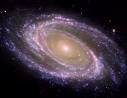
The Big Bang Theory is based on the observation that all the stars and galaxies of the universe are in motion and not stationary. The American astronomer Edwin Hubble (1889–1953) discovered in 1929 that the light of all visible stars was redshifted. Hence the movement of the myriad of galaxies is not random but everything is moving further away. If all galaxies are now racing away from one another then at one point all matter must have been clustered together in an infinitely dense space and its present motion might best be explained by an original explosion of matter. Hence the term Big Bang. The 1965 discovery by Arno Penzias (b. 1933) and Robert Wilson (b. 1936) of the background radiation produced by the intense heat of this "explosion" served to further confirm the theory. The Big Bang Theory brought to an end the idea of a static universe and made respectable again discussions of the beginning and possible creation of the universe. 1
1. Mark Worthing, Encyclopedia of Science and Religion.