Showing posts with label naturalism. Show all posts

Wednesday, January 15, 2014

Angus Menuge Interview Transcript

The following transcript is from an Apologetics 315 interview with Angus Menuge. Original audio here. Transcript index here. If you enjoy transcripts, please consider supporting, which makes this possible.


BA: Hello. This is Brian Auten of Apologetics 315. Today I interview Dr. Angus Menuge, professor of philosophy at Concordia University. He is author of Agents Under Fire: Materialism and the Rationality of Science and many articles on the philosophy of mind, philosophy of science and Christian apologetics. He’s the editor of several collections of essays on C.S. Lewis, Christ in culture, and the scientific vocation.

The purpose of this interview is to find out a bit more about Dr. Menuge, his work in the area of philosophy of mind, the ontological argument from reason, and his advice for Christian apologists.

Well, thanks for taking the time to speak with me today, Angus.

AM: Thank you for having me, Brian.

Saturday, December 14, 2013

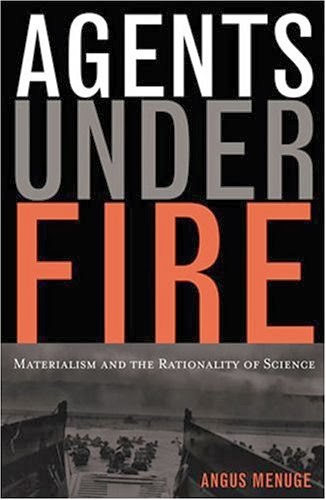
Book Review: Agents Under Fire by Angus Menuge

This reviewer has long been interested in the discussions about the existence of agents. Since the teleological argument depends on the existence of design being a legitimate concept, and that being dependent upon the existence of agents, Angus Menuge's book Agents Under Fire: Materialism and the Rationality of Science was quite appealing. This reviewer balked at the price on Amazon, but it was given as a gift, and this reviewer was ecstatic delve into it immediately. The book is 215 pages divided into eight densely packed chapters. This review is designed to be a chapter-by-chapter summary to prepare the reader to tackle this challenging text.

Preface
Dr. Menuge begins the preface of the book by stating that his purpose behind writing Agents Under Fire is to defend the existence of agency (a non-natural entity capable of reasoning and purposing). He explains that this is a pivotal question in debates about intelligent design, for if there is no agency then there is no agents to design anything (to compare the "designs" in nature to)- design even is an illegitimate concept and should be completely discarded.

Saturday, December 07, 2013

Book Review: The Philosophy of History: Naturalism and Religion by James Stroud

With a title like The Philosophy of History: Naturalism and Religion, it is not surprising to find that the theses James Stroud defends in this book pertain to historiography and the impact of historical method on the assessment of religious claims. But what is surprising about a book with this title and focus is its similarity to the myriad introductory works of apologetics available today, which present an accessible treatment of common apologetic issues, ranging from the origins of the universe and the grounding of morality to the historical Jesus.

Stroud has two central theses in The Philosophy of History, one of which gets more attention than the other. His primary thesis is the claim that naturalism should not be assumed a priori in historical and scientific studies; an “open” methodology which allows for both natural and supernatural explanations should be employed instead of the currently popular “closed” methodology wherein only naturalistic explanations are tolerated. Stroud also defends a secondary thesis, which claims that there is a greater overlap or unity between science and history than is often recognized. In particular, he argues that certain “past singularities” (one-time historical events) such as the origin of the universe, of life, and of humanity, are, though often classified as matters of ‘origins science’, equally at home under the umbrella of history. Stroud repeatedly makes statements like “Origins science is really ‘history’ (or history as a weak science[1]…)”[2] and “…the historian is more capable of addressing questions of origin science with philosophy as an aid than the operation scientist.”[3] “Moreover,” he says, “weaker sciences such as anthropology and sociology as well as linguistics all fall under the much larger umbrella of ‘history.’”[4] This second thesis receives the most attention in the fourth chapter, “What about History?” Though interesting, this point apparently lacks methodological import, for as Stroud ventures into historical and scientific issues later in the book, they are treated in pretty much exactly the same way that they have typically been treated in recent discussion, even to the point of employing unaltered or mostly unaltered versions of arguments used by William Lane Craig, J. P. Moreland, Stephen C. Meyer, Gary Habermas, and others.

Sunday, June 09, 2013

Brendan Sweetman on the Faith of Secularism

"For the secularist, the belief that everything that exists is physical is based on faith in part; it cannot be fully proven by rational argument or by appeal to the evidence. In particular, the secularist has not proved that the human mind (consciousness, thoughts, ideas, etc.) is physical. Of course, he might believe that it is physical or hope to prove it one day (a misguided hope, I hold), but right now he believes this on faith. He might claim that it is a rational faith; whatever about this point, it is still a belief based partly on faith."

—Brendan Sweetman
Why Politics Needs Religion: The Place of Religious Arguments in the Public Square (pp. 119-120). Kindle Edition.

Tuesday, January 15, 2013

Terminology Tuesday: Naturalism, Natural Theology

Naturalism, Natural Theology: Naturalism sometimes refers to a form of atheism and materialism that maintains that the "natural" universe (composed of energy and matter and based on natural laws) is the sum total of reality, thereby negating human freedom, absolute values and, ultimately, existential meaning. As an ethical theory naturalism suggests that ethical judgments arise out of or are based in the universe itself or "the ways things naturally are." Natural theology maintains that humans can attain particular knowledge about God through human reason by observing the created order as one locus of divine revelation.1

1. Stanley J. Grenz, David Guretzki & Cherith Fee Nordling, Pocket Dictionary of Theological Terms (Downers Grove, IL: InterVarsity Press, 1999), p. 82.

Monday, April 30, 2012

Philosopher Interview: R. Scott Smith

Today's interview is with R. Scott Smith, Associate Professor of Ethics and Christian Apologetics at Biola University (previous interviews here and here). He talks about his latest book, Naturalism and Our Knowledge of Reality (review here), defining naturalism, motivations for naturalism, methodological naturalism, ways of viewing reality, Darwinian views, the evolutionary argument against naturalism (similarities/differences), naturalism's ontological resources, some objections to his view, testing religious truth-claims, and more.

Full Interview MP3 Audio (90 min)

Books by R. Scott Smith include:
• Naturalism and Our Knowledge of Reality
• Virtue Ethics and Moral Knowledge
• Truth and the New Kind of Christian: Emerging Effects of Postmodernism in the Church

Enjoy.
Subscribe to the Apologetics 315 Interviews podcast here or in iTunes.

Saturday, April 28, 2012

Book Review: Naturalism and Our Knowledge of Reality by R. Scott Smith

Philosophical naturalism, “a thesis that reality consists solely of the physical, spatiotemporal world,”[1] is the dominant philosophy of the modern West. Starting from the Enlightenment, naturalism has had the effect of creating and sustaining the fact/value split, which in turn has had terrible consequences for our culture. Reason is considered separate from, and superior to, Imagination; empirical facts are considered ‘real’ over against morality, which is shoved off into a corner of private, personal opinions; and a self-fulfilling cycle is created in which scientists declare that only physical explanations of human behavior are viable explanations, and then dismiss what they cannot thereby explain as not real. The church has not been immune to this shift in culture; indeed, a tacit acceptance of the fact/value split has happened in many Christian communities, eroding the basis for solid faith and rendering evangelism both less urgent and less effective.

But what if philosophical naturalism is false, and could be shown to be false? Then the fact/value divide would be recognized as a faulty human construct, not a feature of reality; moral truth would have the same epistemological status as empirical facts; imagination would be rediscovered as an essential way of knowing; and science would be enriched by gaining firm ground for knowledge claims. The stakes are high; it is an endeavor worth pursuing.

Sunday, February 20, 2011

Sunday Quote: Bradley Monton on Methodological Naturalism

"If science really is permanently committed to methodological naturalism – the philosophical position that restricts all explanations in science to naturalistic explanations -  it follows that the aim of science is not generating true theories. Instead, the aim of science would be something like: generating the best theories that can be formulated subject to the restriction that the theories are naturalistic. More and more evidence could come in suggesting that a supernatural being exists, but scientific theories wouldn’t be allowed to acknowledge that possibility."

- Bradley Monton, author of Seeking God in Science: An Atheist Defends Intelligent Design

[HT: Faith Interface]

Sunday, December 19, 2010

Sunday Quote: C.S. Lewis on Naturalism

"If all that exists is Nature, the great mindless interlocking event, if our own deepest convictions are merely the by-products of an irrational process, then clearly there is not the slightest ground for supposing that our sense of fitness and our consequent faith in uniformity tell us anything about a reality external to ourselves. Our convictions are simply a fact about us-like the colour of our hair. If Naturalism is true we have no reason to trust our conviction that Nature is uniform."

- C.S. Lewis, Miracles, p.109

Thursday, April 23, 2009

Plantinga's Evolutionary Argument Against Naturalism MP3 Audio

Philosopher Alvin Plantinga's evolutionary argument against naturalism purports to show that metaphysical naturalism, when combined with contemporary evolutionary accounts of the origin of human life, is self-defeating. (wikipedia) It is worth a listen. His outline can be found here or in PDF.

Full MP3 Audio here from Veritas.org.

Enjoy.

Sunday, February 10, 2008

Christianity vs. Scientific Naturalism Debate MP3

A debate between Dr. William Lane Craig and Dr. Garrett Hardin.
This was an interesting debate. Hardin's answer to the question asking for the evidence for scientific naturalism was very telling. I will leave this one open to your comments. Enjoy the MP3.

Blog Archive

Amz