Showing posts with label Science. Show all posts

Tuesday, April 29, 2014

Ten Presuppositions of Science

Here is a list of some of the presuppositions of science: (1) the existence of a theory-independent, external world; (2) the orderly nature of the external world; (3) the knowability of the external world; (4) the existence of truth; (5) the laws of logic; (6) the reliability of our cognitive and sensory faculties to serve as truth gatherers and as a source of justified true beliefs in our intellectual environment; (7) the adequacy of language to describe the world; (8) the existence of values used in science (e.g., "test theories fairly and report test results honestly"); (9) the uniformity of nature and induction; (10) the existence of numbers.1

1. William Lane Craig & J.P. Moreland, Philosophical Foundations for a Christian Worldview (Downers Grove, IL: InterVarsity Press, 2003), pp. 348.

Wednesday, January 15, 2014

Angus Menuge Interview Transcript

The following transcript is from an Apologetics 315 interview with Angus Menuge. Original audio here. Transcript index here. If you enjoy transcripts, please consider supporting, which makes this possible.


BA: Hello. This is Brian Auten of Apologetics 315. Today I interview Dr. Angus Menuge, professor of philosophy at Concordia University. He is author of Agents Under Fire: Materialism and the Rationality of Science and many articles on the philosophy of mind, philosophy of science and Christian apologetics. He’s the editor of several collections of essays on C.S. Lewis, Christ in culture, and the scientific vocation.

The purpose of this interview is to find out a bit more about Dr. Menuge, his work in the area of philosophy of mind, the ontological argument from reason, and his advice for Christian apologists.

Well, thanks for taking the time to speak with me today, Angus.

AM: Thank you for having me, Brian.

Saturday, December 14, 2013

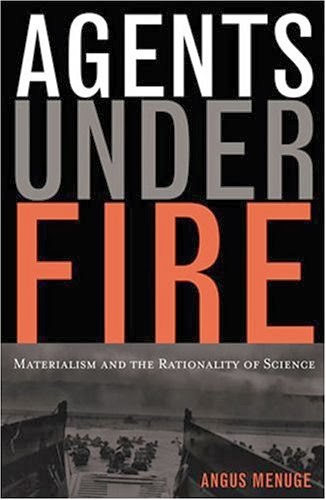
Book Review: Agents Under Fire by Angus Menuge

This reviewer has long been interested in the discussions about the existence of agents. Since the teleological argument depends on the existence of design being a legitimate concept, and that being dependent upon the existence of agents, Angus Menuge's book Agents Under Fire: Materialism and the Rationality of Science was quite appealing. This reviewer balked at the price on Amazon, but it was given as a gift, and this reviewer was ecstatic delve into it immediately. The book is 215 pages divided into eight densely packed chapters. This review is designed to be a chapter-by-chapter summary to prepare the reader to tackle this challenging text.

Preface
Dr. Menuge begins the preface of the book by stating that his purpose behind writing Agents Under Fire is to defend the existence of agency (a non-natural entity capable of reasoning and purposing). He explains that this is a pivotal question in debates about intelligent design, for if there is no agency then there is no agents to design anything (to compare the "designs" in nature to)- design even is an illegitimate concept and should be completely discarded.

Saturday, December 07, 2013

Book Review: The Philosophy of History: Naturalism and Religion by James Stroud

With a title like The Philosophy of History: Naturalism and Religion, it is not surprising to find that the theses James Stroud defends in this book pertain to historiography and the impact of historical method on the assessment of religious claims. But what is surprising about a book with this title and focus is its similarity to the myriad introductory works of apologetics available today, which present an accessible treatment of common apologetic issues, ranging from the origins of the universe and the grounding of morality to the historical Jesus.

Stroud has two central theses in The Philosophy of History, one of which gets more attention than the other. His primary thesis is the claim that naturalism should not be assumed a priori in historical and scientific studies; an “open” methodology which allows for both natural and supernatural explanations should be employed instead of the currently popular “closed” methodology wherein only naturalistic explanations are tolerated. Stroud also defends a secondary thesis, which claims that there is a greater overlap or unity between science and history than is often recognized. In particular, he argues that certain “past singularities” (one-time historical events) such as the origin of the universe, of life, and of humanity, are, though often classified as matters of ‘origins science’, equally at home under the umbrella of history. Stroud repeatedly makes statements like “Origins science is really ‘history’ (or history as a weak science[1]…)”[2] and “…the historian is more capable of addressing questions of origin science with philosophy as an aid than the operation scientist.”[3] “Moreover,” he says, “weaker sciences such as anthropology and sociology as well as linguistics all fall under the much larger umbrella of ‘history.’”[4] This second thesis receives the most attention in the fourth chapter, “What about History?” Though interesting, this point apparently lacks methodological import, for as Stroud ventures into historical and scientific issues later in the book, they are treated in pretty much exactly the same way that they have typically been treated in recent discussion, even to the point of employing unaltered or mostly unaltered versions of arguments used by William Lane Craig, J. P. Moreland, Stephen C. Meyer, Gary Habermas, and others.

Tuesday, October 29, 2013

Terminology Tuesday: Scientism

Scientism: The conviction that scientific knowledge, particularly that derived from the natural sciences, is the highest or even only form of knowledge. Scientism thus depreciates the possibility that ultimate truth can be derived from such areas as moral, aesthetic and religious experience, and it typically rejects the idea that truth can be derived from special revelation.1

1. C.Stephen Evans, Pocket Dictionary of Apologetics & Philosophy of Religion (Downers Grove, IL: InterVarsity Press, 2002), p. 105.

Thursday, October 17, 2013

Edgar Andrews Interview Transcript

The following transcript is from an Apologetics 315 interview with Edgar Andrews. Original audio here. Transcript index here. If you enjoy transcripts, please consider supporting, which makes this possible.


BA: Hello this is Brian Auten from Apologetics 315. Today I interview Edgar Andrews. He is the Ameritus Professor of Materials at the University of London, and an international expert at the science of large molecules, or polymers. He has published well over 100 scientific research papers and books as well as two Bible commentaries and various works on science and religion, and on theology. In addition to an even longer list of impressive credentials and accomplishments, Prof. Andrews is also the author of Who Made God? Searching for a Theory of Everything. The purpose of our interview is to find out more about the relationship between science and faith, discuss Prof. Andrews' book, his apologetic approach, and learn from his experiences. Thank you for taking the time to speak with me today, Prof. Andrews.

EA: Well it's my pleasure.

BA: Would you mind telling our listeners a little more about yourself.

Sunday, August 25, 2013

Johannes Kepler on God and Science

“The chief aim of all investigations of the external world should be to discover the rational order and harmony which has been imposed on it by God and which He revealed to us in the language of mathematics.”

—Johannes Kepler
De fundamentis Astrologiae Certioribus, Thesis XX

Sunday, June 16, 2013

James A. Herrick on Science and Spirituality

"Though science may point to God, we cannot experiment our way to God. Knowledge of the divine and of salvation must be revealed to us by God himself, who ever remains in ultimate control of knowledge as well as of power. No scientific discovery will lead us from the lab to the heavens, though it may take us to space. Nature must be explored as a gift that points us to the Giver, not as an Aladdin's lamp yielding up to the diligent inquirer unlimited powers both physical and spiritual. The biblical message is that transforming grace rather than an evolving human race is the means of discovering our spiritual destiny."

—James A. Herrick

Scientific Mythologies: How Science and Science Fiction Forge New Religious Beliefs (Kindle Locations 3320-3323).

Friday, April 19, 2013

Read Along: Ch2—Are Science and Christianity at Odds?

Today we continue with Chapter Two in the Read Along with Apologetics 315 project. This is a chapter-by-chapter study through the book Is God Just a Human Invention? And Seventeen Other Questions Raised by the New Atheists by Sean McDowell and Jonathan Morrow. (Hear an interview about the book here.) Below you will find an audio intro for Chapter Two, a brief summary of the chapter, a PDF workbook with questions for the chapter, and some notable quotes. You're also encouraged to share your comments and feedback for each chapter in the comment section below. Feel free to interact!

Saturday, March 23, 2013

Book Review: Science and Human Origins

If humans did evolve from ape-like ancestors, the process by which it happened is shrouded in mystery. This isn’t because evolutionary biologists, paleontologists, anthropologists, and geneticists have not been working hard to understand it. Instead, the mystery that surrounds the process stems from the data themselves. As Science and Human Origins makes very clear, what little data we have on the supposed evolution of man is fragmentary and contradictory. The book’s five chapters each discuss a different set of data related to the subject, and when they are all put together, they produce a devastating case against the oft-heard claim that human evolution is well supported by the scientific evidence.

Chapter 1 is written by Dr. Ann Gauger, a developmental biologist who did postdoctoral research at Harvard University. She is now a research scientist at the Biologic Institute, an organization that spearheads original research using the Intelligent Design paradigm. In this chapter, she attempts to make the case against the assumption that common genetic characteristics must be the result of common ancestry via an unguided, neo-Darwinian process.

Friday, March 22, 2013

Jeff Zweerink Interview Transcript

The following transcript is from an Apologetics 315 interview with Jeff Zweerink. Original audio here. Transcript index here. If you enjoy transcripts, please consider supporting, which makes this possible.


BA: Hello, this is Brian Auten of Apologetics315. Today’s interview is with astrophysicist Jeff Zweerink. Jeff is a Research Scholar with Reasons to Believe in southern California, and serves part-time on the physics and astronomy research faculty at UCLA. He is author of Who’s Afraid of the Multiverse? And that’ll be the main topic of our interview today. We’ll be discussing the multiverse hypothesis and its implications for Christian theism. Thanks for joining me today, Jeff.

JZ: It’s good to be here Brian, I’m looking forward to the interview here.

BA: I appreciate you being with me. RTB and all of its resources have been a real blessings, through all your podcasts. I hope our listeners find our discussion helpful as well.

JZ: I would agree, and I’ve found, even before I came to RTB, I kind of found that same thing, it’s kind of a unique set of resources to help integrate both science and the Christian faith. So, I’ve found them useful in the past, that’s part of why I’m here on staff.

Thursday, February 21, 2013

Why is the Universe Fine-Tuned for Life?
Video by Guillermo Gonzales


In this video, from the On Guard Apologetics Conference, Dr. Guillermo Gonzalez talks about recent discoveries in science showing that the universe is fine-tuned for the existence of intelligent life. His talk is followed by a period of Q&A from the audience. A great overview of fine-tuning. Watch the video on YouTube, or download the MP3 audio here. Enjoy.

Monday, January 28, 2013

Apologist Interview: John Bloom

Today's interview is with Dr. John Bloom, professor of physics at Biola University. He's also the Academic Director of the MA Program in Science and Religion at Biola, and the Chair of the Chemistry, Physics, and Engineering Dept. He talks about how he got into science, the faith/science "conflict", countering the faith/science conflict, the history of science and Christianity, naturalism and methodological naturalism, Hume & Darwin, "non-overlapping magisteria", the integration of faith and science, the MA program in Science & Religion at Biola, advice for those defending the faith, Saddleback's Conference on Creation, and more.

Full Interview MP3 Audio here (41 min)

Enjoy.
Subscribe to the Apologetics 315 Interviews podcast here or in iTunes.

Wednesday, December 12, 2012

Saddleback's Apologetics Weekend on Creation

The following audio and video resource is from Saddleback's recent Ahmanson Lecture Series on Creation, which took place on November 24 & 25, 2012. The media page has all the content, but quick links are below. Past apologetics weekend archives for 2009, 2010, and 2011 can be found at Saddleback's page here.

Paul A. Nelson: Darwin or Design? MP3 | Video
Lee Strobel: The Case for a Creator MP3 | Video
Craig Hazen: the Intersection of Science and Faith MP3 | Video
Raymond Bohlin: How Biology Points Toward God MP3 | Video
John Bloom: How the Universe Points Toward a Creator MP3 | Video

Enjoy.

Thursday, November 08, 2012

Interview Transcript: Hugh Ross

The following transcript is from an Apologetics 315 interview with Hugh Ross. Original audio here. If you enjoy transcripts, please consider supporting, which makes this possible.


BA: Hello, this is Brian Auten of Apologetics 3:15. Today I am speaking with astrophysicist Hugh Ross, president and founder of Reasons to Believe, a science/faith think tank based in Southern California. Hugh is author of a number of books, including The Fingerprints of God, The Creator and the Cosmos, Beyond the Cosmos, The Genesis Question, A Matter of Days, Creation as Science, Why the Universe is the Way It Is, and More Than a Theory. The purpose of our interview today is to explore the relationship between faith and science, examine Reasons to Believe's creation model, talk a bit about the Old Earth and Young Earth debate and ask his advice for apologists today.

Right, well thanks for joining me today Hugh, and thanks so much for all the resources that you provide over at Reasons to Believe.

HR: Hello, you're very welcome.

Sunday, August 12, 2012

Keith Ward on the Origin and Nature of the Universe

"To the majority of those who have reflected deeply and written about the origin and nature of the universe, it has seemed that it points beyond itself to a source which is non-physical and of great intelligence and power. Almost all of the great classical philosophers — certainly Plato, Aristotle, Descartes, Leibniz, Spinoza, Kant, Hegel, Locke, Berkeley — saw the origin of the universe as lying in a transcendent reality. They had different specific ideas of this reality, and different ways of approaching it; but that the universe is not self-explanatory, and that it requires some explanation beyond itself, was something they accepted as fairly obvious."

Keith Ward
God Chance and Necessity, Oxford, One World Publications, 1996 p.1. 

Saturday, July 14, 2012

Book Review: Reading God's World: The Scientific Vocation by Angus Menuge

Educators are dependent upon the work of others who establish models, theories, and axioms for our classroom teaching. As Christian educators, it is a joy to discover the seminal thinking of scholars who point us toward the order and Orderer of creation. Such is the case in Reading God’s World: The Scientific Vocation. A series of lectures given beginning on that world-changing day, September 11th, focused on the wedding of science and vocation for the Christian. Five presentations were amplified to ten for this volume whose purpose is not unlike its original intent—demonstrating the biblical worldview of science through the eyes of Christians holding the office of scientist.

Saturday, June 16, 2012

Book Review: Galileo Goes to Jail and Other Myths about Science and Religion by Ronald L. Numbers

In the second half of the nineteenth century, Andrew Dickson White and John William Draper wrongly proposed that science and religion exist in a perpetual state of conflict. (One is reminded of Stephen Gould’s famous demarcation between science and religion as two non-overlapping magisterium.) Historians and scientists who adopted the White-Draper thesis consequently misread several famous episodes in western history in their attempt to confirm the thesis. Although White and Draper’s credibility as researchers has long been discounted, their thesis has proved resilient, filtering down into the popular conception through constant textbook repetition and oft-cited historical “myths” proposing a clash between church and science.

Historian Ronald Numbers (author of The Creationists) has gathered an impressive list of scholars to set the record straight through their exploration of twenty-five “myths” concerning the relationship between science and religion. Interestingly, twelve of the twenty-five contributing authors are atheists or agnostics; one is a Jew, one a Muslim, one a Buddhist, and one a Spinozist. The book can hardly be dismissed as creationist propaganda. The twenty-five myths discussed are as follows:

Saturday, February 25, 2012

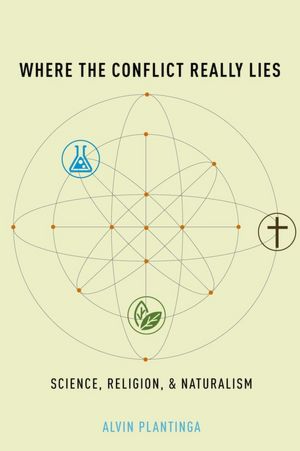
Book Review: Where the Conflict Really Lies: Science, Religion, & Naturalism by Alvin Plantinga

There are few names bigger than Alvin Plantinga when it comes to philosophy of religion and there are few topics more hotly debated than science and religion. Plantinga’s latest book, Where the Conflict Really Lies: Science, Religion, & Naturalism (hereafter WCRL) has therefore generated much interest as it has one of the foremost philosophers of religion taking on this highly contentious topic.
Plantinga minces no words. The very first line of the book outlines his central claim: “there is superficial conflict but deep concord between science and theistic religion, and superficial concord and deep conflict between science and naturalism.”1

The first part of the book is dedicated to the superficial conflict between science and religious belief. The reason this alleged conflict is important is due, largely, to the success of the scientific enterprise. Because science has shown itself to be a reliable way to come to know the world, if religion is in direct conflict with science, then it would seem to discredit religion. Not only that, but, Plantinga argues, Christians should have a “particularly high regard” for science due to the foundations of the scientific enterprise on a study of the world.2

Thursday, January 12, 2012

Can Science Inform Our Understanding of God? MP3 Series

Here is a series of lectures given at the Science and Faith Conference on December 2, 2011, entitled Can Science Inform Our Understanding of God? There is a pretty good lineup of speakers, each covering a topic pertinent to the science/faith issue. Each talk is followed by a response from another speaker. Original audio can be found here at the Conference Website (but the audio files are huge there). See website for videos of each lecture as well. Click to download smaller MP3 files here, or use this RSS feed to get the whole batch in your iTunes or RSS reader.

Dr. Michael Behe - MP3
"The Modern Scientific Theory of Intelligent Design: Strengths and Limitations”
Dr. Stephen Barr - MP3
"Physics, the Nature of Time and Theology”
Dr. Jay W. Richards - MP3
"Signs of Design from Physics and Astronomy”
Dr. Edward Feser - MP3
“Natural Theology Must Be Grounded in the Philosophy of Nature, Not Natural Science”
Dr. Benjamin Wiker - MP3
“Can Science Demonstrate the Existence of God?”
Dr. Alvin Plantinga - MP3
"Science and Religion: Where the Conflict Really Lies”

Enjoy.

Blog Archive

Amz